
Why Great Pickleball Facilities Still Lose Members
Beautiful courts don't guarantee a successful pickleball club. In Part 4 of our series, we explore why some facilities with state-of-the-art courts still struggle to retain members—and why the real secret to success goes far beyond the building itself.
Pickleball Partners - Mike Bowcott
6/30/20263 min read
The Pickleball Club Revolution – Part 4
Why Great Pickleball Facilities Still Lose Members
Walk into a beautiful new pickleball facility and it's easy to be impressed.
Modern courts.
Bright lighting.
High ceilings.
Comfortable viewing areas.
A pro shop.
A café.
Everything looks like a first-class operation.
Yet many of these same facilities quietly struggle with member retention.
Why?
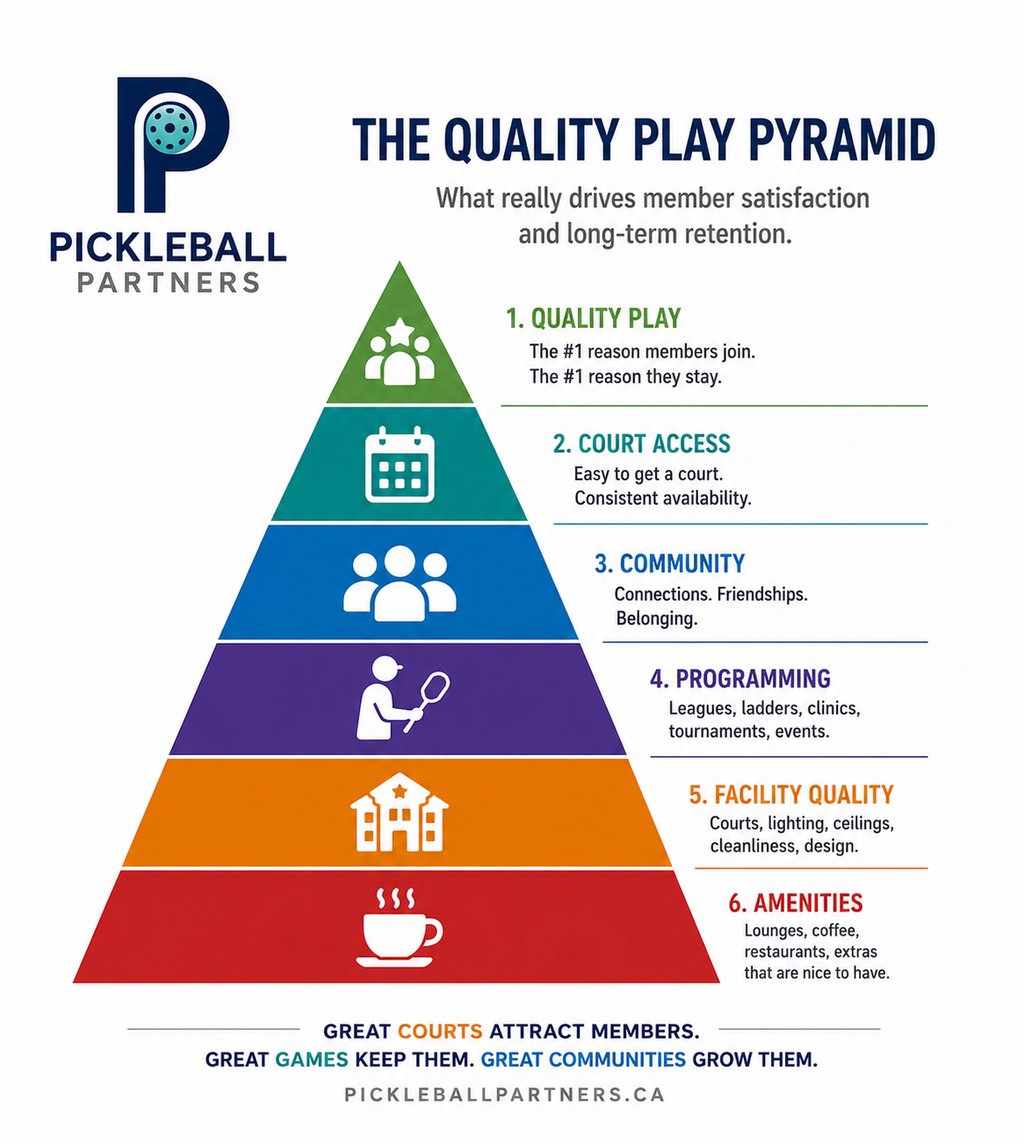
Because while great facilities attract members, they don't necessarily keep them.
That may sound surprising, but one of the biggest misconceptions in the pickleball industry is that success is determined by the quality of the building.
It's not.
The most successful clubs don't simply build great facilities.
They build great experiences.
The Facility Is Only the Beginning
Players certainly notice the physical features of a club.
They care about:
🟡 Court quality
🟡 Lighting
🟡 Ceiling height
🟡 Court spacing
🟡 Temperature and ventilation
🟡 Washrooms and amenities
🟡 Parking
🟡 Viewing areas
These things matter.
In fact, they create an important first impression.
But once the novelty wears off, players begin asking different questions.
Can I book a court?
Can I find players at my level?
Am I improving?
Do I enjoy coming here?
Do I feel like I belong?
Those questions determine whether someone renews their membership.
Great Courts Don't Create Great Communities
Many facility operators assume that once the courts are built, everything else will naturally fall into place.
Players will organize themselves.
Friendships will develop.
Leagues will emerge.
The community will somehow build itself.
Unfortunately, that's rarely how pickleball works.
Pickleball is one of the most social sports in the world, but that doesn't mean community happens automatically.
Unlike many traditional sports, players often arrive individually rather than as part of an established team. They rely on the club to help them find compatible playing partners, appropriate competition, and opportunities to connect.
Without thoughtful programming, many players never find their place.
Beautiful courts cannot solve that problem.
The Quality of Play Matters
Ask experienced pickleball players why they return to a club, and the answer usually isn't the building.
It's the quality of play.
Players want games that are:
🟡 Competitive
🟡 Balanced
🟡 Enjoyable
🟡 Appropriate for their skill level
Nothing frustrates players more than consistently being placed in games that are too strong or too weak.
When players regularly experience mismatched games, they begin looking elsewhere—even if the facility itself is exceptional.
Many clubs focus heavily on attracting new members while giving too little attention to creating consistently enjoyable play for existing ones.
That is often where retention begins to suffer.
Programming Is More Than Filling Courts
Successful clubs don't simply rent court time.
They create reasons for people to come back.
That includes:
🟡 Organized open play
🟡 Skill-based sessions
🟡 Leagues
🟡 Ladders
🟡 Clinics
🟡 Social events
🟡 Tournaments
🟡 Learn-to-play programs
Effective programming creates rhythm and routine.
Members begin recognizing familiar faces.
Friendships develop.
Communities grow.
Players become invested in the club itself—not just the courts.
The Hidden Cost of Member Turnover
Acquiring a new member is expensive.
Advertising.
Marketing.
Sales.
Tours.
Promotions.
Referral incentives.
Every club celebrates new memberships.
Far fewer celebrate renewals.
Yet long-term profitability often depends far more on retaining existing members than constantly replacing them.
A club with excellent retention can grow steadily with much lower marketing costs.
A club with poor retention is forced to keep selling memberships simply to replace the ones it loses.
What Players Should Really Look For
Before joining any private pickleball club, don't just ask about the facility.
Ask about the experience.
Questions worth asking include:
🟡 How does the club match players by skill level?
🟡 What organized programming is available?
🟡 How easy is it to meet new players?
🟡 What percentage of members renew each year?
🟡 How often are leagues and ladders offered?
🟡 What opportunities exist for beginners to improve?
🟡 Is there a strong sense of community?
The answers to those questions often tell you far more than the quality of the courts.
The Best Clubs Deliver More Than Court Time
The strongest pickleball clubs understand something many operators overlook.
Players aren't simply buying access to courts.
They're buying an experience.
They're buying competition.
They're buying friendships.
They're buying routine.
They're buying community.
Courts are simply the platform that makes those things possible.
The facilities that understand this distinction will build loyal members.
The ones that don't may continue attracting players—but struggle to keep them.
Final Thoughts
The private and public pickleball industry is entering a new phase.
Building courts is no longer enough.
The facilities that thrive over the next decade will be those that deliver exceptional player experiences—not just exceptional buildings.
Great courts attract attention.
Great experiences create loyal members.
And loyal members build great clubs.
Coming Next
Part 5: The Membership Model Problem
Not all membership models are created equal.
Some encourage healthy participation and long-term sustainability.
Others unintentionally create frustration, overcrowding, and declining member satisfaction.
We'll examine why the structure of a membership model may be even more important than its price—and why the most successful clubs of the future may look very different from today's unlimited-play model.
Coming Soon >>>
Part 6: The Secret Ingredient That Turns Courts Into Communities