
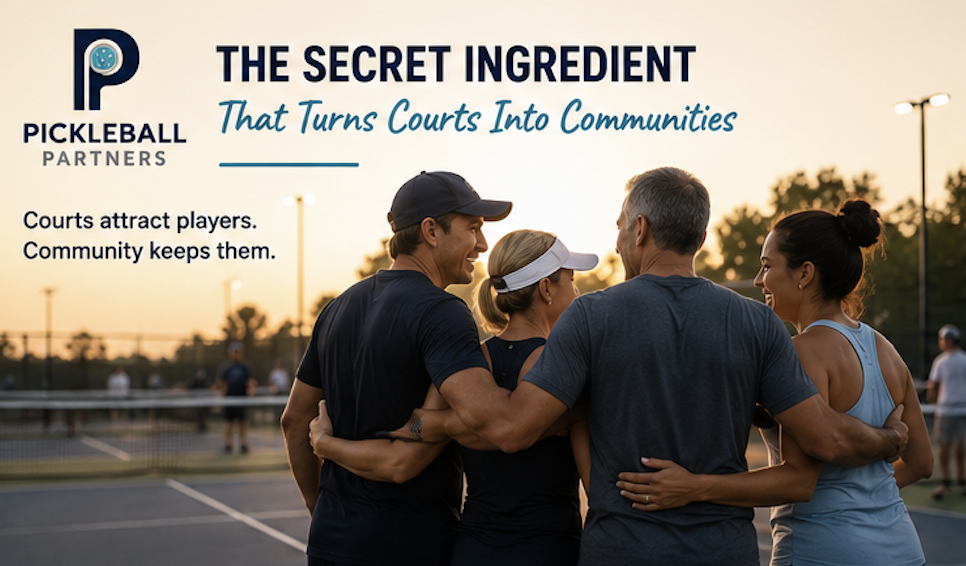
The Secret Ingredient That Turns Courts Into Communities
Beautiful courts attract players, but they don't create thriving clubs. The most successful pickleball facilities—whether public or private—understand that people return because of friendships, quality play, programming, and a genuine sense of belonging. In Part 6 of The Pickleball Club Revolution, we explore the often-overlooked ingredient that transforms a collection of courts into a true pickleball community.
Pickleball Partners - Mike Bowcott
7/14/20263 min read
Walk into almost any new pickleball facility and you'll immediately notice the courts.
The lighting.
The ceiling height.
The colour scheme.
The pro shop.
The lounge.
The amenities.
These things matter.
They create a strong first impression.
But here's what many facility operators—both private and public—eventually discover:
Great facilities don't automatically create great clubs.
That's because people don't return week after week simply because the courts are beautiful.
They return because of what happens on those courts.
And more importantly...
Who they meet on them.
Pickleball Is Different
Most sports are built around existing teams.
Pickleball is different.
Every day, thousands of people walk into a facility knowing nobody.
They're hoping someone will welcome them.
They're hoping they'll find players at a similar level.
They're hoping they'll leave feeling better than when they arrived.
That first experience often determines whether they come back.
It isn't the quality of the floor.
It's the quality of the experience.
The Real Journey Every Player Takes
Every pickleball player follows a surprisingly similar journey.
"I've heard about pickleball."
↓
"I'll give it a try."
↓
"I hope I don't embarrass myself."
↓
"I met some really nice people."
↓
"I found players around my skill level."
↓
"I'm improving."
↓
"I can't wait to play again."
↓
"This feels like my club."
That's the journey every successful facility should be helping players take.
Because once players feel they belong...
Retention becomes much easier.
Courts Don't Build Communities
People do.
That's one of the biggest misconceptions in pickleball today.
Some municipalities assume that once they build courts, the community will organize itself.
Some private operators believe that if they build enough courts, members will naturally keep renewing.
Neither assumption is entirely true.
Courts create opportunities.
Communities require intention.
They require leadership.
Programming.
Volunteer ambassadors.
Club partnerships.
Social events.
Leagues.
Ladders.
Beginner clinics.
Skill development.
These aren't simply programs.
They're community builders.
Why Quality Play Matters
One lesson has become increasingly clear.
Players will often travel farther—and sometimes pay more—to consistently find great games.
Finding players with similar skill levels creates better rallies, more enjoyable competition, faster improvement, and stronger friendships.
Quality play isn't just a nice feature.
It's one of the foundations of a successful pickleball community.
Facilities that help players consistently find balanced games build stronger member loyalty than those that simply provide court reservations.
The Community Flywheel
Successful clubs create momentum.
It often looks like this:
New Player
↓
Learns the Game
↓
Meets People
↓
Finds Balanced Games
↓
Joins Leagues and Events
↓
Improves
↓
Invites Friends
↓
Community Grows
↓
More New Players
Once that flywheel starts turning, remarkable things happen.
Word-of-mouth becomes your best marketing.
Programming fills more quickly.
Volunteer leaders emerge.
Members become ambassadors.
Retention improves.
The community begins to grow itself.
Public and Private Facilities Face the Same Challenge
Whether a facility is privately owned or municipally operated, the challenge is remarkably similar.
Private clubs need members to renew.
Municipal facilities need residents to remain engaged and continue using the courts.
In both cases, long-term success depends on much more than simply building infrastructure.
It depends on creating experiences people want to return to.
Forward-thinking municipalities are beginning to understand this.
They're investing not only in courts, but also in programming, partnerships, events, coaching, and community development.
Likewise, the most successful private operators recognize that they aren't just managing courts.
They're cultivating relationships.
The Secret Ingredient
After spending years coaching players, organizing leagues, building clubs, and watching thousands of people discover the sport, I've come to one simple conclusion.
People don't fall in love with facilities.
They fall in love with the people they meet inside them.
That's the secret ingredient.
Courts attract players.
Community keeps them.
And in the years ahead, I believe the clubs and municipalities that understand this distinction will be the ones that truly thrive.
Coming Next
Part 7: The Future of Pickleball
The pickleball boom is entering a new phase.
Private clubs are expanding.
Municipalities are investing.
Technology is reshaping operations.
Players are becoming more discerning.
In Part 7, we'll look ahead and explore where the industry is heading over the next five years—and which organizations will be best positioned to succeed.