
The Private Pickleball Club Revolution: Not All Clubs Are Created Equal
Private pickleball clubs are expanding across the GTA. Before spending thousands on a membership, players need to know what questions to ask.
Pickleball Partners - MIke Bowcott
6/7/20265 min read
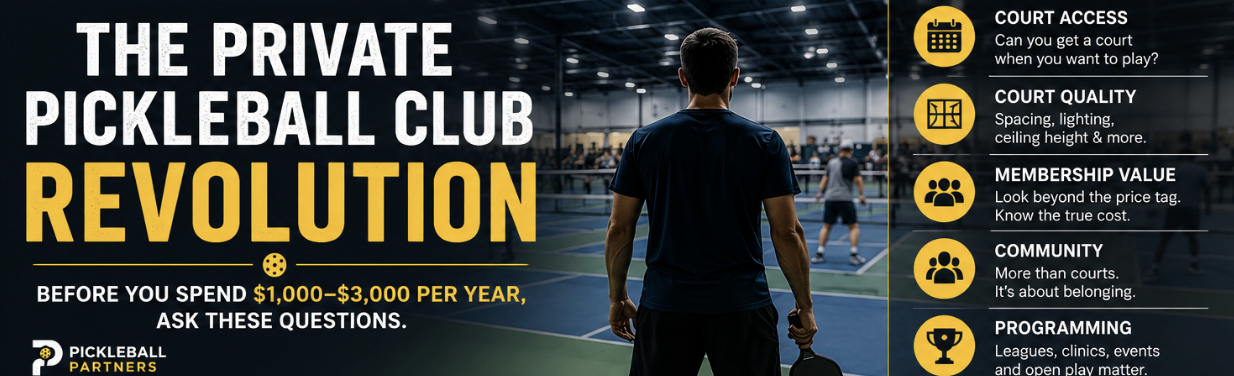
Not All Pickleball Clubs Are Created Equal
The questions every player should ask before spending $1,000 to $3,000 a year on a private pickleball membership.
Private pickleball clubs have arrived and more are coming.
Across the GTA, players are now seeing a wave of indoor facilities, private clubs, social clubs, hybrid clubs, and premium lifestyle concepts built around one of the fastest-growing sports in North America.
For pickleball players, this is exciting.
More courts.
More choices.
More indoor options.
More places to play year-round.
But it also creates a new challenge.
Private pickleball is not cheap.
Many players are now being asked to consider memberships that can range from roughly $700 per year to more than $3,000+ per year once fees, court bookings, open play, programs, lessons, tournaments, guest passes, and taxes are included.
That means players need to start asking better questions.
Because not all pickleball clubs are created equal.
The First Question Should Not Be Price
Most players naturally start with the obvious question:
How much does it cost?
That matters.
But it is not the only question.
In some cases, it may not even be the most important one.
A low membership fee does not help much if you cannot get court time.
A premium facility may look impressive, but that does not mean it will deliver the best playing experience.
A club with many courts may still feel crowded if it sells too many memberships.
A smaller facility may provide excellent access if it manages membership properly.
The real question is not simply:
“What does the membership cost?”
The better question is:
“What am I actually getting for that membership?”
Court Access Is Everything
For most pickleball players, access to courts is the deciding factor.
Players want to know:
Can I get a court when I want to play?
Can I find quality games?
Can I book at peak times?
Will open play be well organized?
Will I be competing with too many other members for too few courts?
This is where the conversation needs to shift.
The key metric players should begin asking about is simple:
How many active members are sharing each court?
A facility with 6 courts and 300 active members may offer a very different experience than a facility with 11 courts and 1,500 members.
Both may advertise themselves as private indoor pickleball clubs.
But the actual member experience could be completely different.
Membership Caps Matter
As private clubs grow, one question will become increasingly important:
Are memberships capped?
If they are capped, at what level?
And more specifically:
How many members per court does the club have and how many are they targeting?
This is a question many players are not asking yet and most private clubs have not considered or disclosed.
But they should.
A club can sell memberships aggressively in the beginning. That may help the business raise revenue and build momentum. But if too many members are added without enough court capacity, access begins to deteriorate.
Suddenly, the facility looks good on paper but becomes frustrating in practice.
Players may have paid for access to a club, but what they really bought was competition for limited court time.
Court Count Does Not Tell the Whole Story
Court count matters.
But it is only one part of the equation.
Players should also look at:
Court spacing
Run-off areas
Distance from fencing or walls
Ceiling height
Lighting quality
Surface quality
Acoustics
Booking rules
Open play structure
Skill-level organization
A facility may advertise a large number of courts, but if those courts are tightly spaced, poorly lit, or limited by low ceilings, the playing experience may not match the marketing.
Likewise, a facility with fewer courts may feel better if the spacing, lighting, ceiling height, and programming are excellent.
Players should not just ask:
“How many courts do you have?”
They should ask:
“What kind of courts are they?”
The Rise of Different Club Models
The GTA market is already starting to separate into different types of facilities.
Some clubs are pure pickleball facilities.
Some are fitness and lifestyle clubs with pickleball included.
Some are membership-plus-court-fee models.
Some are unlimited-play models.
Some are targeting retirees and serious daily players.
Others are targeting working professionals, families, social players, and people looking for a premium club experience.
None of these models are automatically right or wrong.
But they are different.
And players need to understand what they are buying.
A serious player who wants to play five times per week may value unlimited play and strong competition.
A working professional may value convenience, amenities, and evening booking access.
A family may care more about junior programs, social space, and multi-sport options.
A newer player may care most about open play, clinics, and finding people at the right level.
The best club for one player may not be the best club for another.
Municipal Facilities Will Change the Market
There is another important factor on the horizon.
Municipalities are eventually going to become more serious competitors.
We are already seeing this in places like Newmarket, where large-scale municipal pickleball infrastructure is moving forward.
If municipalities build properly, price fairly, and work with strong clubs or experienced operators, they could become formidable competitors to private facilities.
Why?
Because municipalities do not need to operate with the same profit expectations as private clubs.
They can focus on access, affordability, community benefit, and participation.
That does not mean municipalities will automatically get it right.
Running a successful pickleball facility requires far more than building courts and collecting fees.
It requires programming, scheduling, skill-level management, community building, court utilization strategy, membership flexibility/options and a deep understanding of how pickleball players actually behave.
But if municipalities learn this, the private club market will have to compete not just on courts, but on value, experience, and community.
The Hidden Factor
There is one thing that separates successful pickleball clubs from facilities that simply have courts.
It is harder to measure than price.
It does not always show up in the membership brochure.
But players feel it almost immediately.
Some places become communities.
Others remain buildings with nets.
That difference will matter more and more as competition grows.
Players will not stay long-term just because a facility is new.
They will stay because the club becomes part of their routine, their social life, their improvement, and their identity as players.
The clubs that understand this will have an advantage.
The ones that do not may struggle once the novelty fades.
What This Series Will Cover
Over the coming weeks, Pickleball Partners will be taking a closer look at the private pickleball club market and the questions players should be asking before they join.
We will explore:
Why court access matters more than headline pricing
Why members-per-court may become the most important metric
Why court quality, spacing, lighting, and ceiling height matter
How membership fees, court fees, open play fees, and program fees add up
The difference between unlimited, pay-as-you-play, and hybrid models
How municipalities may eventually reshape the private club market
What makes a pickleball facility sustainable
How players should decide which club is right for them
This is not about attacking private clubs.
Private investment is important.
Canada needs more indoor pickleball options.
But players deserve to understand what they are buying.
And operators need to understand that success will require more than simply opening courts.
Final Thought
The private pickleball club market is entering an important phase.
Players will have more choices than ever.
That is a good thing.
But with more choice comes more confusion.
The best membership will not always be the cheapest.
The most expensive club will not always provide the best value.
The largest facility will not always provide the best access.
And the nicest-looking courts will not always create the strongest community.
Before players spend serious money, they should ask better questions.
Because in the next stage of pickleball growth, the winning clubs will not be the ones with the flashiest marketing.
They will be the ones that deliver access, quality, value, and a reason for players to keep coming back.
Coming Next in This Series
Article #2: The Most Important Question Nobody Is Asking — How Many Members Are Sharing Each Court?

