
The Private Club Gold Rush Reshaping Pickleball in York Region / GTA- Part II
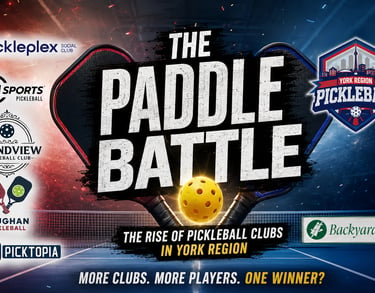
What began on taped gym floors and basketball courts has now evolved into a full-scale battle for players, memberships, and community ecosystems across York Region and the GTA. Private operators, boutique clubs, flexible pay-as-you-go concepts, and large-scale franchise models are all racing to stake their claim in Canada’s fastest-growing recreational industry. In Part 2 of this series, we explore: * the rise of private pickleball clubs, * the fragmentation of the original player ecosystem, * why “community” may matter more than courts, * the emergence of mega-facilities like Backyard Club, * and why the coming membership wars may reshape pickleball in Canada.
Pickleball Partners
5/25/20264 min read

Part 2 — The Private Club Gold Rush
In Part 1 of this series, we explored the grassroots origins of pickleball in York Region:
taped gym floors,
basketball courts,
church halls,
volunteer-run leagues,
and the tightly connected player communities that helped ignite the sport’s explosive growth.
But eventually demand reached a level that temporary solutions could no longer support.
Players wanted:
indoor courts,
dedicated facilities,
organized leagues,
consistent competition,
and year-round access to the game.
That demand created opportunity. And suddenly, pickleball was no longer simply a recreational movement. It was becoming a business.
The first wave of private operators entered the market:
Pickleplex, Vaughan Pickleball Club(formerly known as HiSports) and others.
Then came smaller boutique concepts like Pictopia and Grandview.
Another interesting model emerged through Fairgrounds Pickleball with its more flexible pay-as-you-go approach. Rather than focusing entirely on recurring memberships, Fairgrounds emphasized accessibility, social play, and lower-commitment entry points. It was a very different approach to the market and helped introduce even more players to organized pickleball.
But now another evolution is beginning to emerge:
the luxury ecosystem club.
Perhaps the boldest example yet is The Backyard Club, slated to open in late 2026 near the Steeles and Alness area in North Toronto. The Backyard Club is positioning itself as far more than just another pickleball facility. The project is expected to feature 21 pickleball courts — making it the largest indoor pickleball facility in Ontario — combined with food, wellness concepts, training, and broader lifestyle-oriented amenities.
This is no longer simply about renting court time.
The entire market is evolving.
And that evolution is raising bigger questions.
What exactly are operators trying to build?
A premium club?
A social hub?
A competitive training centre?
A flexible recreational model?
A lifestyle destination?
Or a scalable franchise ecosystem?
Right now, the Canadian pickleball landscape feels a little like the Wild West.
Everyone is racing to stake their claim.
And honestly, it makes sense.
Demand is still enormous.
Many clubs are full.
Leagues are filling quickly.
Prime-time court availability remains limited.
And players are still searching for consistent, quality play.
But there is also a major shift quietly happening underneath the surface.
The original pickleball ecosystem is fragmenting.
Players who once belonged to one centralized community — such as York Region Pickleball, which operated under a flexible pay-as-you-go model and helped build one of the largest connected pickleball communities in Canada — are now spreading across York Region and the GTA in search of dedicated courts, stronger competition, and different playing experiences.
Groups like York Region Pickleball helped introduce thousands of players to the sport during a time when dedicated infrastructure barely existed. Many players were willing to play almost anywhere:
gym floors at Trio,
temporary pop-up courts,
community centres,
and shared recreational spaces.
Eventually, many of those same players gravitated toward the dedicated indoor facilities private operators began building.
Now those players are spreading across:
multiple clubs,
different memberships,
competing leagues,
various apps,
and entirely separate ecosystems.
The talent pool is spreading out. The atmosphere changes. The competitive depth changes.
And operators are no longer simply competing against a shortage of courts.
They are now competing in a much more complex environment shaped by:
pricing,
convenience,
programming,
court availability,
location,
player experience,
and rapidly evolving consumer expectations.
This is where many operators may still be underestimating what ultimately drives long-term success. Some are beginning to recognize that the next phase of pickleball may reward operators very differently than the first.
The facilities that survive long term may not necessarily be the ones with:
the biggest buildings,
the most courts,
the flashiest branding,
or the earliest market entry.
Because pickleball is rapidly becoming about much more than simply providing courts. This is one reason the arrival of large American franchise models like The Picklr Canada is so significant. These operators are not simply opening facilities.
They are building structured membership ecosystems featuring:
leagues,
clinics,
tournaments,
subscriptions,
coaching systems,
and standardized operating models across multiple markets.
It is a much more mature approach to the business. And it raises the stakes for everyone else.
At the same time, larger facilities are beginning to emerge across Ontario as operators recognize something important:
Scale creates advantages.
Large facilities can offer:
deeper player pools,
greater scheduling flexibility,
stronger league potential,
more consistent activity,
and broader programming opportunities.
Players naturally gravitate toward places where:
they can reliably find games,
competition is strong,
activity is constant,
and the overall experience feels dynamic.
That network effect is becoming increasingly important.
And as more facilities open, another major shift is quietly approaching:
The membership wars.
Founder memberships.
Retention pricing.
Premium tiers.
Flexible models.
Unlimited play concepts.
Players who once had almost no options are now being flooded with choices.
And that may be the single biggest change of all.
For years, pickleball players simply went wherever they could find a court. Some travelled 30 to 60 minutes just to play.
Now players are becoming far more selective.
They are evaluating:
value,
quality of play
convenience,
flexibility,
availability,
and long-term fit.
Which means players may want to think carefully before rushing into long-term commitments while the market is still evolving so rapidly.
Because the next phase of pickleball in York Region may reshape the landscape yet again.
And some of the biggest changes may still be ahead.
In Part 3, we take a deeper look at the rise of mega-facilities like Backyard Club, the battle for player ecosystems, and why scale may become one of the defining forces shaping the future of pickleball in Canada.


My post content