
The Pickleball Club Revolution – Part 5: The Membership Model Problem
As private and public pickleball facilities expand across Canada, membership models are becoming one of the most important—and least understood—factors shaping the player experience. Unlimited play, pay-as-you-play, hybrid memberships, tiered pricing and municipal access models all have strengths and weaknesses. The real question is whether the model delivers sustainable court access, quality play and long-term member satisfaction.
Pickleball Partners - Mike Bowcott
7/6/20268 min read
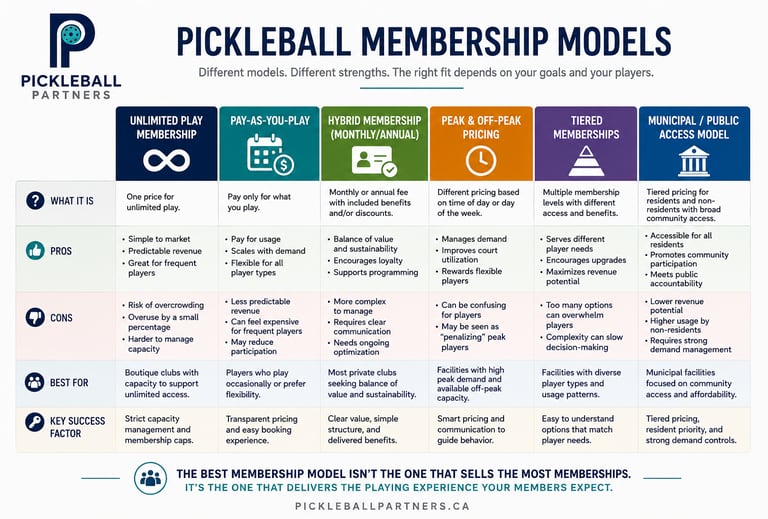
My post content
The Pickleball Club Revolution – Part 5: The Membership Model Problem
The pickleball facility industry is entering an important new phase.
For the past several years, the primary challenge was simple:
Build more courts.
Demand was growing faster than supply, municipalities were struggling to keep up, and private operators began filling the enormous gap in indoor pickleball infrastructure.
Today, the conversation is changing.
More private facilities are opening.
Players have more choices.
Membership prices are rising.
Competition is increasing.
And a much more difficult question is emerging:
What is the right membership model for a pickleball facility?
There is no simple answer.
Unlimited play.
Monthly memberships.
Annual memberships.
Pay-as-you-play.
Discounted court fees.
Free memberships with higher court fees.
Tiered memberships.
Peak and non-peak pricing.
Resident and non-resident pricing.
Each model can work.
Each model can also fail.
The real issue is not whether a membership model looks attractive on a website.
The question is whether the model creates a sustainable balance between player value, court access, quality of play, facility utilization, and financial performance.
And that is where many facilities are beginning to run into problems.
The Membership Price Is Only the Beginning
When players compare pickleball facilities, the first number they usually see is the membership fee.
$69 per month.
$99 per month.
$150 per month.
$2,000 per year.
Free membership.
Unlimited play.
No court fees.
Fifty percent off court fees.
Fourteen-day priority booking.
The offers can be difficult to compare because every facility structures access differently.
But the membership price tells you surprisingly little about the actual value of the membership.
A $100 monthly membership can be an excellent value if players consistently find good games and convenient court access.
A $2,000 annual membership can be worth every dollar if the facility delivers an exceptional playing experience.
A free membership can become expensive if every court reservation, program, league, and open play session carries additional fees.
And an unlimited membership can become almost worthless if too many members are competing for too few courts.
That is why players need to look beyond the price.
What exactly are you buying?
The Unlimited Play Model
Unlimited play is probably the most attractive offer in pickleball.
It is easy to market.
Pay one price.
Play as much as you want.
No court fees.
No complicated calculations.
For highly active players, the value proposition can be extremely compelling.
But unlimited play creates one of the most significant challenges in the pickleball facility business.
The players receiving the greatest value from the membership are often the players consuming the most court capacity.
If the facility continues selling memberships without carefully managing the relationship between membership growth and available court hours, the consequences are predictable.
Booking becomes more difficult.
Prime-time availability disappears.
Open play becomes crowded.
Waitlists grow.
Players begin competing for access.
And eventually, the membership promise and the actual member experience begin moving in opposite directions.
Unlimited play itself is not necessarily the problem.
Unmanaged unlimited play is the problem.
An unlimited model requires disciplined capacity management, strong booking policies, utilization monitoring, programming controls, and a clear understanding of how many active players the facility can realistically support.
Without those controls, the model can become a victim of its own success.
The Pay-As-You-Play Model
At the opposite end of the spectrum is pay-as-you-play.
Players pay for the court time, open play, leagues, clinics, tournaments, or programs they actually use.
There are several advantages.
Players have financial participation in the capacity they consume.
Revenue increases with facility usage.
Court demand becomes easier to measure.
And operators can use pricing to influence behaviour and move demand from peak periods into underutilized hours.
But there are disadvantages as well.
Highly active players may feel they are constantly reaching for their wallets.
The total cost of playing can become difficult to predict.
Players may participate less frequently.
And if every interaction with the facility feels transactional, it becomes more difficult to create loyalty and a sense of belonging.
Pay-as-you-play can be an effective economic model.
But a facility cannot simply become a building that rents courts.
There has to be something more.
The Hybrid Membership Model
Increasingly, facilities are experimenting with hybrid models.
Members pay a monthly or annual membership fee and receive benefits such as:
• Priority booking
• Reduced court fees
• Discounted programming
• Free or discounted open play
• Guest privileges
• Access to leagues, tournaments, and social events
• Peak and non-peak benefits
The hybrid model has an important advantage.
It creates recurring membership revenue while maintaining some relationship between facility usage and what players pay.
It can also allow operators to create different levels of membership for players with different needs.
The occasional player should not necessarily purchase the same membership as someone playing five days per week.
The daytime player may not require the same access as the prime-time player.
The competitive tournament player may value different programming than the recreational social player.
The challenge is complexity.
Too many membership tiers, booking rules, restrictions, credits, discounts, and exceptions can leave players confused about what they are actually buying.
The strongest hybrid models are not necessarily the ones offering the most options.
They are the ones where players can quickly understand:
What do I pay?
What do I receive?
When can I play?
How easily can I get a court?
The Membership Cap Question
This may become one of the most important questions in the pickleball facility industry.
How many members can a facility support?
Not how many memberships can it sell.
How many members can it support while still delivering the playing experience those members were promised?
Those are very different numbers.
A facility with six courts has different capacity constraints than a facility with 21 courts.
A club where members play twice per month has different capacity requirements than a club filled with highly active players who play four or five times per week.
The number of memberships alone is not enough.
Operators need to understand:
• Members per court
• Active members per court
• Peak-time demand
• Court-hour utilization
• Booking success rates
• Waitlists and unfulfilled demand
• Average playing frequency
• Member retention and churn
Eventually, players are going to start asking facilities a very simple question:
Are you capping memberships?
And if so:
At what point?
Facilities that cannot answer that question may eventually find that their most active members answer it for them—by leaving.
Not Every Player Wants the Same Membership
One of the biggest mistakes in membership design is assuming every pickleball player behaves the same way.
They don't.
Some players want unlimited play.
Some want one scheduled game every week.
Some primarily play during weekday mornings.
Others can only play evenings and weekends.
Some want competitive leagues and tournaments.
Some want social open play.
Some want clinics and instruction.
Some simply want access to a court with three friends.
A successful membership strategy recognizes these differences.
That does not necessarily mean creating ten different membership categories.
It means understanding the different types of players using the facility and designing access around actual demand.
The membership model should serve the operating strategy.
The operating strategy should not be forced to accommodate a poorly designed membership model.
Private Facilities and Municipal Facilities Are Not the Same Business
This distinction is extremely important.
Private pickleball facilities and municipal recreation facilities should not automatically operate under the same membership model.
Private operators have investors, leases, debt obligations, staffing costs, and profitability requirements.
Their membership strategy must generate sufficient recurring revenue while supporting sustainable facility utilization.
Municipalities have a different responsibility.
They are primarily accountable to residents and taxpayers.
Their objective should include affordability, accessibility, participation, programming, community development, and responsible use of publicly funded infrastructure.
That creates an opportunity for municipalities to develop membership structures that private operators may find difficult to replicate.
Resident pricing.
Non-resident pricing.
Junior memberships.
Senior memberships.
Daytime memberships.
Family memberships.
Pay-as-you-play options.
Seasonal access.
Program-based memberships.
Different booking windows.
Peak and non-peak pricing.
A properly designed municipal facility can serve a much broader population while still using pricing and access policies to manage demand.
But simply copying the membership model of a private pickleball club would be a mistake.
Municipal facilities need their own operating model.
And that model must begin with understanding the community they are serving.
The Real Problem Is Capacity Allocation
Behind every membership model is the same scarce resource.
Court time.
There are only so many courts.
There are only so many prime-time hours.
There are only so many players who can use those courts.
The purpose of a membership model is not simply to generate revenue.
It is a system for deciding:
Who gets access?
When do they get access?
How much do they pay?
How frequently can they play?
How is demand managed when everyone wants the same court time?
Those decisions directly affect member satisfaction.
A poorly designed membership model can create the very problems the facility was built to solve.
Too many members.
Not enough court access.
Overcrowded open play.
Difficulty finding quality games.
Frustrated players.
Declining retention.
A strong membership model aligns the economics of the facility with the experience of the player.
That balance is far more difficult to achieve than simply choosing a monthly membership price.
Price Must Be Connected to Value
In the Quality Play Pyramid I introduced in Part 4, price was initially missing.
That was an oversight.
Price matters.
For many players, it matters enormously.
But price cannot be evaluated in isolation.
The cheapest facility is not necessarily the best value.
The most expensive facility is not necessarily the best experience.
Value is created by the relationship between:
Price.
Quality of play.
Court access.
Programming.
Community.
Facility quality.
Players will pay more when they believe the experience justifies the cost.
They will tolerate fewer amenities if the games are excellent.
They may accept higher court fees if access is reliable.
They may remain loyal to an older facility because of the people and community they have found there.
The question is not simply:
How much does the membership cost?
The better question is:
What playing experience am I receiving for what I am paying?
The Membership Model Is a Promise
Every membership sold creates an expectation.
Access.
Availability.
Quality games.
Programming.
Community.
Value.
The membership model is the mechanism the facility uses to deliver that promise.
If too many memberships are sold, access deteriorates.
If prices are too low, the facility may struggle financially.
If prices are too high, players may leave.
If everything is unlimited, capacity can become difficult to control.
If everything carries an additional fee, players may never feel like members.
There is no perfect membership model.
But there are membership models that are aligned with facility capacity, player behaviour, and operating strategy.
And there are membership models that are not.
As competition increases, the difference will become increasingly visible.
Because players now have choices.
And if a facility cannot consistently deliver the playing experience its members expect, eventually those players will find somewhere else to play.
Final Thoughts
The next phase of the pickleball facility industry will not simply be about building more courts or selling more memberships. It will be about designing better operating models. The successful facilities will understand that membership revenue, court utilization, quality of play, player experience, and retention are interconnected. Private operators will need to determine how many members their courts can realistically support.
Municipalities will need to develop tiered, accessible membership structures that reflect their responsibility to residents while protecting court availability.
And players will need to become more sophisticated consumers.
Before joining a facility, they should ask:
How many courts are there?
How many active members are sharing them?
Are memberships capped?
What happens when demand exceeds capacity?
How much will I actually pay to play?
And most importantly: will I consistently get the playing experience I am paying for?
Because the best membership model is not the one that sells the most memberships.
It is the one that creates a sustainable facility, satisfied players, and a reason for those players to keep coming back.