
Part 3 — The Battle of the Business Models
The pickleball industry is entering a new phase. As boutique facilities, franchise operators, and luxury destination clubs race to capture market share, the question is no longer whether pickleball will grow — it's which business models will ultimately survive. In Part 3, we explore the emergence of mega-clubs like Backyard Club, the expansion strategies of operators such as Pickleplex, and the changing expectations of players who now have more choices than ever before. From premium experiences to flexible membership models, the battle for the future of pickleball is just beginning.
Pickleball Partners - Mike Bowcott
6/1/20263 min read
The Evolution of Pickleball in York Region — And the Tsunami Few See Coming
Part 3 — The Battle of the Business Models
The first phase of pickleball growth was simple. Players just wanted somewhere to play.
The second phase brought the private club gold rush, as operators rushed to meet the demand for indoor courts, leagues, and organized play.
Now the industry is entering a third phase.
The battle of the business models.
For the first time, players are no longer choosing between having a place to play and having nowhere to play. They are choosing between entirely different visions of what pickleball should become. And nobody knows which model will ultimately win.
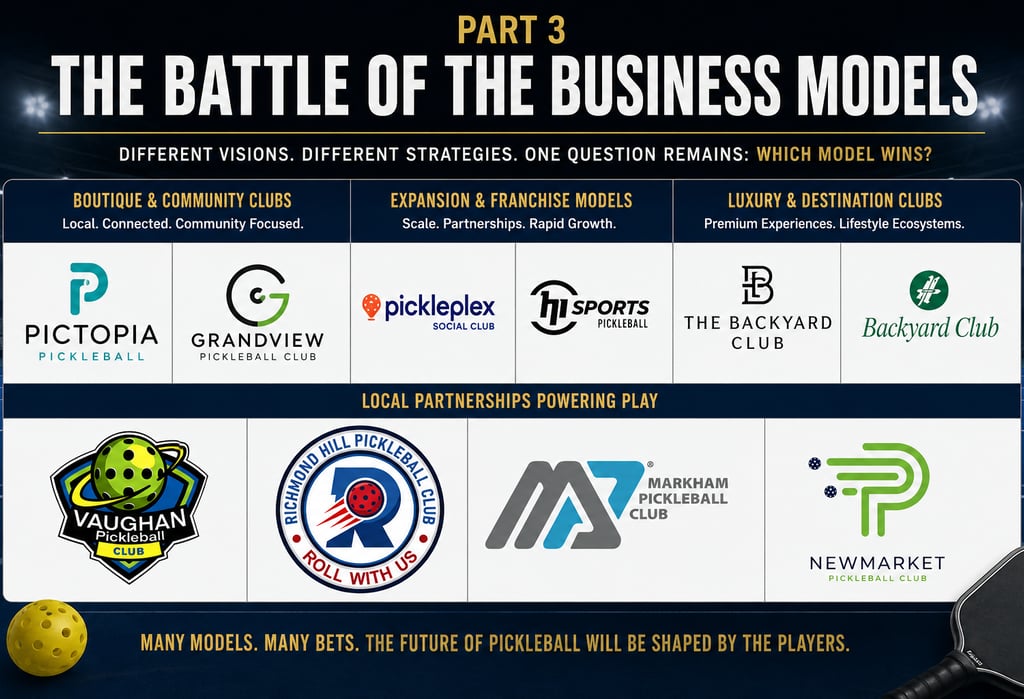
Some operators are pursuing the boutique club model.
Smaller facilities.
Local communities.
Flexible programming.
Lower overhead.
Others are pursuing rapid expansion through franchise systems.
Perhaps the most visible example in Ontario today is Pickleplex.
Pickleplex has made a significant splash across York Region and the GTA by opening multiple facilities and partnering with local pickleball organizations to help activate courts and programming.
It is an interesting approach.
Rather than trying to build everything from scratch, the model leverages existing pickleball communities and experienced local operators to help create playing opportunities and organized programs.
Richmond Hill Pickleball Club is currently piloting programming at Pickleplex Aurora, while Vaughan Pickleball Club has developed a strong presence at Pickleplex Vaughan.
The strategy appears to recognize something many operators eventually discover:
Building courts is one challenge. Building activity is another. At the other end of the spectrum sits an entirely different vision.
The luxury destination club.
The most ambitious example announced so far is The Backyard Club.
Scheduled to open in late 2026 near Steeles and Alness in North Toronto, The Backyard Club is expected to feature 21 indoor pickleball courts, making it the largest indoor pickleball facility in Ontario.
But the facility is not being positioned as simply a pickleball club.
Food.
Events.
Wellness.
Training.
Social spaces.
The concept appears to be aimed at creating a premium lifestyle experience built around the sport. It is also one of the most ambitious pricing and membership models announced to date. Whether the GTA pickleball market is mature enough to support a facility of this scale and positioning remains one of the most fascinating questions facing the industry.
Some players will undoubtedly embrace the concept. Others may find themselves questioning whether the added amenities justify the premium pricing.
Time will tell.
Then there are operators pursuing entirely different strategies.
Pay-as-you-go models.
Membership-light models.
Programming-first models.
Tournament-focused models.
The reality is that the industry is still experimenting.
And that may be the most important takeaway of all.
Despite pickleball's explosive growth, there is still no clear blueprint for long-term success.
Every operator is making a bet.
Some are betting on scale.
Some are betting on convenience.
Some are betting on premium experiences.
Some are betting on accessibility.
Some are betting on brand.
Others are betting on location.
The challenge is that player expectations are evolving rapidly.
A few years ago, players were willing to travel almost anywhere simply to find a court.
Today they have options.
And tomorrow they will have even more.
Players are increasingly evaluating:
value,
convenience,
availability,
location,
programming,
quality competition,
flexibility,
and overall experience.
As more facilities open, competition will intensify. The membership wars are already beginning. Founder memberships. Discounted renewals. Premium tiers. Unlimited play models. Promotional offers. Retention incentives.
The easy growth phase may be ending.
The next phase will be much more competitive.
And while private operators are busy competing with one another, another force is quietly building beneath the surface. A force that could fundamentally alter the economics of pickleball across Canada. Because the biggest future competitor to private operators may not be another private operator at all.
In Part 4, we examine the Municipal Tsunami — and why cities like Newmarket, Vaughan, and Markham may ultimately play a much larger role in the future of pickleball than many private operators currently realize.