
Not All Pickleball Courts Are Created Equal
Municipalities and facility operators often promote the number of pickleball courts they have built. But what actually counts as a pickleball court? Dedicated courts, lined tennis courts, seasonal pop-up courts, and indoor facilities all provide very different player experiences. In Part 3 of The Pickleball Revolution, we examine why court quality matters far more than court counts.
Pickleball Partner - Mike Bowcott
6/21/20265 min read
Imagine two communities.
Each reports having 20 pickleball courts.
On paper, they appear identical.
A resident reading a municipal report might reasonably conclude that both communities have made a similar investment in pickleball infrastructure.
But what if one community has 20 dedicated pickleball courts with permanent nets, proper spacing, and year-round programming?
And the other has a mix of lined tennis courts, temporary seasonal installations, and portable nets set up on repurposed surfaces?
Are those really the same thing?
Most players would say no.
Yet across North America, pickleball infrastructure is often measured using court counts alone.
That approach may be simple.
But it can also be misleading.
Because not all pickleball courts are created equal.
The Court Count Problem
Pickleball participation continues to grow at an extraordinary pace.
Municipalities are under pressure to respond.
Private operators are investing millions of dollars in new facilities.
Consultants are producing recreation master plans and infrastructure studies.
Everyone is trying to answer the same question:
"How much pickleball infrastructure do we have?"
The problem is that many inventories count very different types of facilities as though they are equivalent.
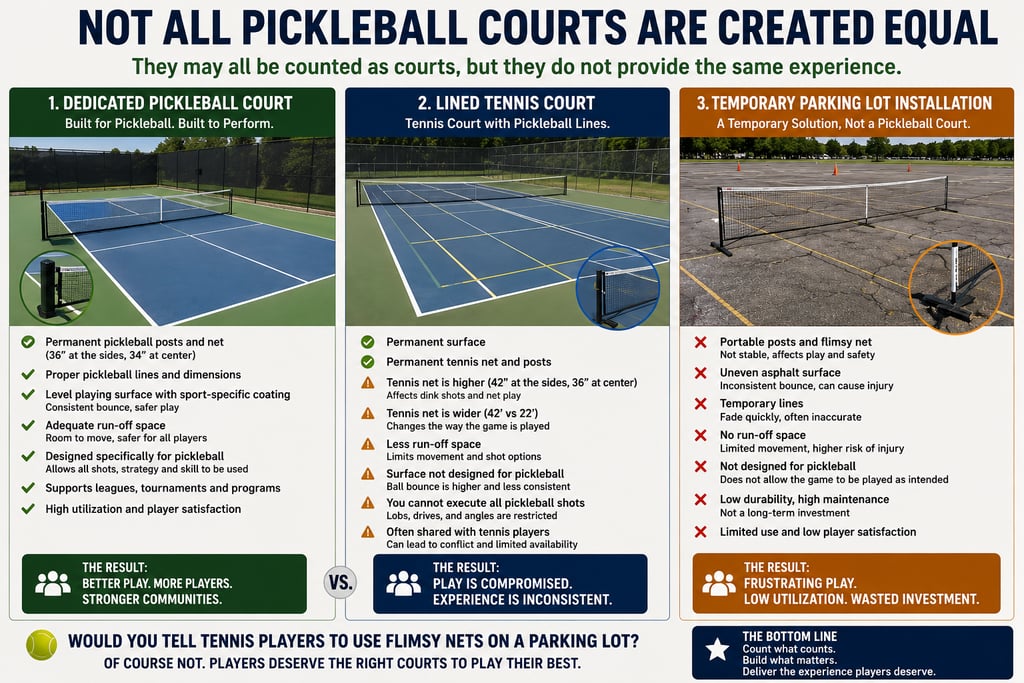
A dedicated indoor pickleball court is not the same as a dedicated outdoor court.
A dedicated outdoor court is not the same as a lined tennis court.
A lined tennis court is not the same as a temporary court on a parking lot.
Each has a role to play.
But they do not provide the same player experience.
The Indoor Advantage
From a pure playing perspective, indoor courts offer the most consistent experience.
No wind.
No rain.
No weather cancellations.
No sun glare.
No seasonal shutdowns.
Indoor facilities also provide safer and more predictable playing conditions throughout the year.
That consistency is one reason demand for indoor pickleball continues to grow across Canada.
The challenge, of course, is cost.
Indoor facilities are expensive to build and operate.
As a result, players often pay through memberships, court fees, leagues, lessons, or programming.
Why Outdoor Courts Still Matter
Despite the advantages of indoor play, outdoor courts remain the foundation of pickleball growth.
They are:
• Accessible
• Affordable
• Community-oriented
• Highly visible
• Often free to use
Many players discover the sport on outdoor courts.
Many of the strongest pickleball communities in North America were built around outdoor hubs.
But outdoor courts have limitations.
Weather affects access.
Wind affects play.
Seasonality affects utilization.
In much of Canada, outdoor courts operate for only part of the year.
That reality means communities need both indoor and outdoor infrastructure.
The goal should not be choosing one or the other.
The goal should be creating the right balance.
The "Build It and They Will Come" Myth
One of the biggest misconceptions in pickleball infrastructure planning is the belief that if you simply build courts, the sport will organize itself.
It won't.
Pickleball is unique because the courts are only one part of the equation.
Unlike tennis, where players typically arrive with a partner and reserve a court, pickleball is driven by community, organized play, skill matching, leagues, clinics, ladders, tournaments, and social interaction.
New players don't just need a court.
They need a pathway into the sport.
They need opportunities to meet players of similar skill levels.
They need organized programming that helps them improve, connect, and become part of a community.
The most successful pickleball facilities understand this.
They don't simply provide courts.
They create experiences.
They create opportunities for play.
They create communities that keep players coming back.
Unfortunately, some municipalities still approach pickleball as though it were simply a court-building exercise.
Add a few courts.
Paint a few lines.
Install a few nets.
Then wait for the players to figure everything else out.
That approach often leads to underutilized facilities, frustrated players, and missed opportunities.
Because the reality is simple:
Courts attract players.
Communities retain them.
What Is A Dedicated Pickleball Court?
A dedicated pickleball court is designed specifically for pickleball.
It includes:
• Permanent pickleball posts
• Permanent pickleball nets
• Permanent pickleball lines
• Proper run-off space
• A level playing surface
• A surface designed for predictable ball bounce and player safety
Dedicated courts provide a consistent experience.
They support leagues.
They support tournaments.
They support coaching.
And they support long-term growth.
Most importantly, they are built with pickleball as the primary purpose.
The Checkbox Inventory Problem
Many municipalities have discovered relatively inexpensive ways to increase their pickleball inventory.
They can:
• Add pickleball lines to tennis courts
• Install temporary nets
• Convert parking lots
• Create seasonal pop-up locations
These solutions can be useful.
In many cases, they help introduce players to the sport and provide short-term capacity.
The problem occurs when temporary solutions are counted the same as permanent infrastructure.
A lined tennis court remains primarily a tennis court.
A parking lot remains a parking lot.
A temporary net remains a temporary net.
Useful?
Absolutely.
Equivalent to a dedicated pickleball court?
No.
The distinction matters because inventory numbers influence planning decisions, public perception, and future investments.
A Tale of Two Municipalities
Consider two municipalities taking different approaches to pickleball infrastructure.
Newmarket currently offers dedicated outdoor pickleball courts, temporary lined courts, and is constructing a 20-court indoor facility that will dramatically expand year-round access.
Richmond Hill currently offers dedicated pickleball courts, seasonal pop-up courts located on repurposed parking lot surfaces, and lined tennis courts that are frequently included in pickleball inventory calculations.
On paper, the numbers may appear comparable.
The player experience is not.
Dedicated courts, lined tennis courts, and temporary seasonal facilities all serve different purposes.
Each can contribute to a community's recreation strategy.
But they should not automatically be treated as equivalent measures of infrastructure capacity.
That raises an important question.
Are we measuring courts?
Or are we measuring meaningful pickleball access?
Because those are not the same thing.
Beyond Benchmarking
Another challenge facing municipalities is how success is measured.
Many planning studies rely heavily on benchmarking.
Benchmarking can be valuable.
But the results depend on who you compare yourself against.
If a municipality compares itself primarily against communities with limited pickleball infrastructure, it may conclude it is doing well.
If it compares itself against leading municipalities investing in dedicated courts, indoor facilities, and pickleball hubs, it may reach a different conclusion.
The goal should not be to meet the lowest standard.
The goal should be to understand actual community demand and determine whether existing infrastructure is meeting that demand.
The municipalities making the most progress are often those that actively engage with players, clubs, and user groups throughout the planning process.
They focus on participation, utilization, and player experience—not simply inventory counts.
Players Experience Facilities, Not Statistics
The next time you hear that a municipality has added pickleball courts, ask a few simple questions:
What kind of courts are they?
How often are they used?
How often are they available?
How many months of the year are they operational?
How many players can realistically use them?
Those answers matter far more than the inventory number itself.
Because players experience facilities.
Not statistics.
Final Thoughts
The next phase of pickleball growth will not be determined by who reports the largest court inventory.
It will be determined by who builds the best infrastructure.
Infrastructure that is accessible.
Infrastructure that is affordable.
Infrastructure that is durable.
Infrastructure that delivers a quality playing experience.
And infrastructure that recognizes a simple reality:
Not all pickleball courts are created equal.
Coming Next
Part 4: Why Great Facilities Still Lose Members
Some facilities have beautiful courts, modern amenities, and significant investment behind them.
Yet they still struggle to retain players.
Why?
Because courts alone do not create a great pickleball experience.
In Part 4, we'll explore one of the most overlooked factors in the industry: quality of play.
Coming Soon
Part 5: The Membership Model Problem
Part 6: The Secret Ingredient That Turns Courts Into Communities



My post content