
Niagara-on-the-Lake and the Pickleball Planning Lesson Municipalities Cannot Ignore
The pickleball challenges in Niagara-on-the-Lake are often framed as a noise issue — but the real story is about planning. This article explores how court placement, proximity to homes, undersized facilities, and a lack of long-term thinking created avoidable conflict around one of Ontario’s fastest-growing sports. It also looks at what municipalities can learn from the Virgil court closure, the newer Queenston Heights courts, and why centralized hubs, proper setbacks, and collaboration with local clubs are essential to getting pickleball right. At its core, this is not a story about whether pickleball belongs. It is a story about why municipalities must plan for how the sport actually works — before demand, complaints, and costly mistakes force them to react.
Mike Bowcott - Pickleball Partners
4/27/20265 min read
Niagara-on-the-Lake and the Pickleball Planning Lesson Municipalities Cannot Ignore
Why This Was Never Really a Noise Problem — It Was a Planning Problem
The situation unfolding in Niagara-on-the-Lake has become one of the most important municipal pickleball case studies in Ontario. At first glance, it appears to be a story about noise complaints. But when you step back and look at the full picture, something else becomes clear:
This was never really a pickleball problem.
It was a planning problem.
The Background: How Niagara-on-the-Lake Got Here
For several years, the pickleball courts in Virgil became increasingly popular. Demand grew quickly.
Players embraced the facility.
The local club expanded.
Participation increased.
But so did tension.
Nearby residents raised concerns about:
Sound levels
Increased usage
Proximity to homes
Constant play throughout the day
Noise mitigation efforts were attempted. Restrictions followed. Eventually, the situation escalated into legal and operational conflict.
The result was a familiar municipal pattern:
Court closures
Municipal expense
Community frustration
Club disruption
Uncertainty about long-term access
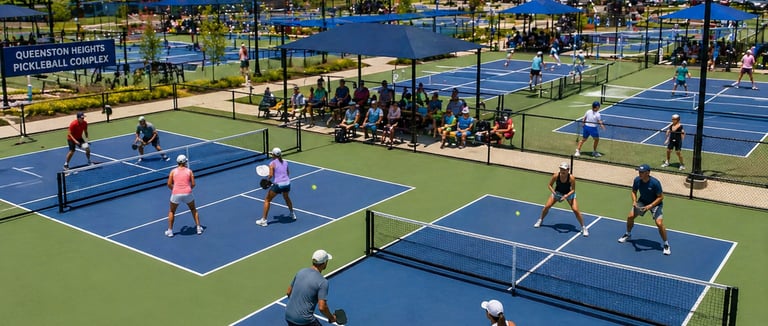
Meanwhile, the Town has since invested in new courts at Queenston Heights Park — a location that better reflects what many municipalities are beginning to understand:
Location matters just as much as court count.
The Courts Were Simply Too Close to Homes
This is the uncomfortable but important reality. The original courts should never have been placed so close to nearby residential properties. Pickleball is different from tennis.
It generates:
More frequent paddle-to-ball contact
Longer periods of continuous play
Higher player turnover
Larger social gathering patterns
Increased daily usage
Because of this, pickleball requires a different planning standard.
Recommended Setback Distances
Based on growing municipal experience and planning best practices:
Minimum practical setback: ~150 metres
Preferred planning distance: 200–300 metres
Best practice: separation combined with natural buffers, parking, landscaping, and open recreational space
Municipalities often underestimate this. Available land gets identified. Courts get placed. But once dedicated pickleball courts become popular, usage patterns change dramatically.
Why Tennis Thinking Often Creates Pickleball Problems
Many municipalities still plan pickleball using a traditional tennis framework.
That usually means:
Converting underused tennis courts
Adding a few pickleball lines
Squeezing courts into neighbourhood parks
Treating pickleball as a secondary activity
The problem?
Pickleball Is Not Tennis — And It Shouldn’t Be Planned Like It Is
Pickleball and tennis are often grouped together in municipal recreation strategies, but they are fundamentally different sports with very different usage patterns.
Many tennis and pickleball strategy reports have reached a similar conclusion:
The two sports should not be mixed wherever possible, and lining tennis courts for pickleball should be considered only as a temporary or last-resort solution.
Unfortunately, some municipalities continue to rely on lined tennis courts as a way to appear to increase pickleball access without fully understanding how those courts are actually used.
The result is often predictable:
Low utilization of one or two courts on a tennis court
Ongoing disputes between tennis and pickleball players when three or more courts are lined
Scheduling conflicts
Confusion around priority of use
A false sense of “court supply” that does not reflect real demand
Many cities count lined tennis courts as part of their pickleball inventory. That may be acceptable if those courts are actively used — rather than simply serving as a way to check a box and inflate the reported number of available courts.
But rarely do they ask the more important question:
Are people actually using them?
In many cases, the answer is no. Players gravitate toward dedicated pickleball environments where they know they can find games, meet others, and participate in organized play. This is why dedicated hubs consistently outperform scattered lined courts. Pickleball succeeds when it is planned for how it is actually played — not simply added onto existing infrastructure designed for another sport.
Pickleball Is a Hub Sport
Pickleball thrives when players know:
“If I show up, I’ll get a game.”
That creates natural gathering points. Dedicated courts become magnets.
Players travel to them.
Groups organize around them.
They become social destinations.
And that means usage concentrates quickly.
The Four-Court Mistake
One of the most common municipal mistakes is building too few courts. Four courts sounds reasonable. But in practice? Four courts often become overcrowded almost immediately.
What Happens Next
Players discover the courts quickly
Organized groups begin using them
Wait times increase
Parking pressure rises
Complaints begin
Demand exceeds capacity almost immediately
For pickleball, undersized facilities create their own problems. A centralized four-court location may technically exist — but functionally, it often fails to meet demand. Players may wait 20–40 minutes between games. It can take two hours to play only a few matches.
And then municipalities find themselves facing the same realization:
“We didn’t build enough.”
The Reality of Dedicated Pickleball Courts
Dedicated courts are not isolated park amenities.
They function more like:
Small recreation destinations
Organized social hubs
Community gathering spaces
Structured play environments
Because of this, planning must account for:
Higher daily usage
Clustering of players
Waiting and social areas
Parking demand
Organized programming
Why Queenston Heights Represents a Better Direction
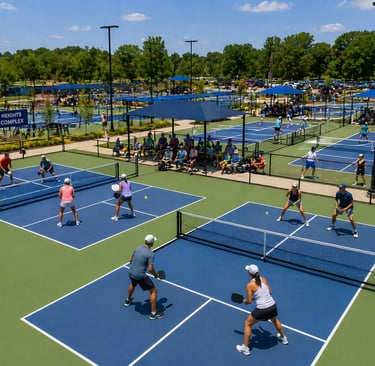
The newer courts at Queenston Heights Park demonstrate a more thoughtful approach.
Instead of placing courts within a residential conflict zone, the Town moved toward:
A larger recreational setting
Better separation from homes
Integrated amenities
A destination-style environment
This approach aligns far more closely with how pickleball should be planned.
The Missing Ingredient: Club Collaboration
Municipalities often overlook an important reality:
The people who understand pickleball best are usually the clubs.
Local clubs understand:
Demand patterns
Peak play times
How players organize
What makes facilities successful
Where growth is heading
When municipalities collaborate early with clubs, they avoid expensive mistakes later.
The Bigger Lesson for Municipalities
The Niagara-on-the-Lake experience is not a warning against pickleball. It is a warning against poor planning.
Too often, municipalities:
Underestimate growth
Build too small
Place courts too close to homes
Rely on short-term fixes
Revisit the same problem years later
A Better Roadmap for Municipal Planning
If municipalities want to avoid repeating this situation, the path is clear.
1. Plan for Growth — Not Current Demand
Pickleball expands quickly.
What feels adequate today may be undersized tomorrow.
2. Build Larger Centralized Hubs
Instead of scattered small sites, consider:
8–16+ court facilities
Proper setbacks
Managed access
Organized programming
Shared amenities
3. Respect Setback Distances
Noise complaints are often planning failures. Proper separation matters.
4. Work With Clubs
Clubs are not the problem. They are often the solution.
5. Think Long-Term
Avoid:
Temporary fixes
Underbuilding
Counting lined tennis courts as meaningful supply
Final Thought
The Niagara-on-the-Lake story is not about whether pickleball belongs. It clearly does.
The lesson is simpler:
Pickleball succeeds when planning succeeds.
Niagara-on-the-Lake recognized that the original Virgil courts created conflict because of location and proximity to homes. In many ways, the Town corrected that mistake by shifting toward a more suitable location at Queenston Heights Park. That was an important step. But another planning challenge may already be emerging. While four dedicated courts are a meaningful improvement, they may not be enough to meet long-term demand. Dedicated pickleball courts naturally become gathering places.
Players travel to them.
Clubs organize around them.
Participation grows quickly.
And when facilities are undersized, a familiar pattern often follows:
Long wait times
Crowded play conditions
Parking pressure
Increased demand for expansion
In other words:
Niagara may have solved the location problem — but may soon face a capacity problem.
This is not criticism. It is simply the predictable reality of how pickleball grows. Municipalities often build for today’s demand rather than tomorrow’s participation. And that is where planning matters most. The real opportunity is not just building courts. It is building enough courts, in the right places, designed for how the sport actually functions.
Because once again, the lesson remains clear:
Pickleball is not the issue. Planning is.
Need Help Planning Pickleball in Your Community?
Pickleball Partners works with municipalities, clubs, and facility operators to help communities:
Understand real pickleball demand
Avoid common planning mistakes
Design successful court layouts
Improve programming and utilization
Create long-term indoor and outdoor strategies
We provide consulting, facility planning insight, programming models, and community engagement strategies.
👉 Contact Pickleball Partners to discuss your community’s pickleball future.
Email us: pickleballpartnerscanada@gmail.com