
How a Town of 43,000 Built One of Canada’s Best Pickleball Facilities — And Why Even 12 Courts Are No Longer Enough
In a city of just 43,000 residents, Vernon built one of Canada’s most impressive pickleball facilities — a 12-court indoor complex created through community leadership, volunteerism, and long-term vision. What began as a small local club grew into a movement that united players, raised millions, secured land, and built a destination facility that now serves more than 1,200 members. But Vernon’s story is more than a success story. It is also a reality check. Today, the club has 500 people on a waiting list — and likely many more who no longer bother signing up because access feels out of reach. This article explores how Vernon built its facility, what municipalities can learn from its remarkable growth, and why even well-planned infrastructure can quickly become undersized when pickleball demand explodes. Because in pickleball, the lesson remains the same: Planning for today is rarely enough.
Mike Bowcott - Pickleball Partners
5/4/20266 min read
Vernon Pickleball: How a Community of 43,000 Built One of Canada’s Most Inspiring Pickleball Facilities
What Happens When Demand, Leadership, and Community Come Together
Welcome to Vernon, British Columbia.
A city of roughly 43,000 people.
Not Toronto. Not Vancouver. Not Calgary.
Yet this small community has accomplished something many much larger municipalities still struggle to deliver:
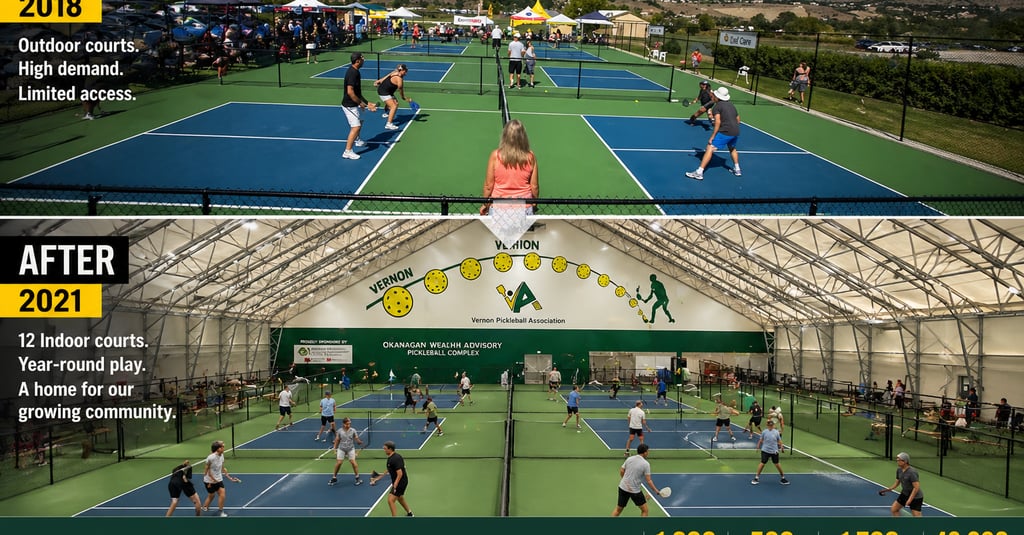
A 12-court indoor pickleball facility built largely through community effort, volunteerism, and club leadership.
But the story of Vernon is not just about courts.
It is about what happens when a community recognizes demand early, works together, and refuses to wait years for a traditional municipal process to catch up.
The Beginning: A Small Game With Big Demand
Like many communities, pickleball in Vernon started quietly.
Around 2014–2015, people discovered the game through recreation programs, gyms, schools, and local word-of-mouth.
Players borrowed paddles.
Courts were temporary.
Indoor gymnasium time was limited.
But demand grew quickly.
At first, there were a few hundred players.
Then 400.
Then 600.
Then 800.
People wanted to play — but there were not enough places to do it.
The local recreation model looked familiar:
Shared gym space
Limited court inventory
Temporary scheduling
Long waitlists
Crowded play sessions
Players rotated through informal paddle racks and homemade systems just to determine who played next.
It was manageable for a while.
But then something changed.
The Problem Municipalities Often Miss
Pickleball does not behave like many traditional recreation programs.
It grows quickly.
Once players discover the sport, participation expands rapidly.
And unlike many individual sports, pickleball creates social gathering patterns.
People do not just play.
They stay.
They socialize.
They organize.
They bring friends.
That is exactly what happened in Vernon.
The club began using tennis courts across the city.
Courts were lined.
Play spread throughout multiple locations.
But soon, those courts were full from morning to evening.
And with that came another challenge:
The courts were never designed to support that level of concentrated activity.
Nearby homes experienced increasing activity.
Parking increased.
Large social groups gathered.
And the city realized something many municipalities eventually learn:
Pickleball needs infrastructure built for pickleball.
A Community Decision: Stop Waiting — Build Something Better
As demand continued to grow, a conversation began within the pickleball community.
Instead of constantly chasing court time, moving between schools, sharing tennis courts, and competing for limited access, one question emerged:
What if we built something ourselves?
That question changed everything.
At the time, there were two separate pickleball clubs in Vernon.
One of the first and most important decisions was to unite.
The clubs came together.
A shared vision formed.
And instead of asking for a few more courts, they began thinking bigger.
Much bigger.
The Municipal Plan Was Too Small
The city had considered eventually building three or four courts.
Maybe in four, five, or even seven years.
But local leaders knew that would not work.
The demand already existed.
And by the time those courts were completed, they would likely be undersized.
So the club proposed something different:
Twelve Dedicated Courts
Not scattered
Not temporary
Not shared
Not reactive
A centralized facility.
Purpose-built.
Designed for long-term growth.
The Power of a Vision
One of the project leaders created detailed drawings of what the facility could become.
They researched costs.
They studied construction.
They built financial projections.
And then they did something many clubs never attempt:
They Spent Nearly Two Years Presenting the Idea
To municipal leaders.
To boards.
To stakeholders.
To anyone willing to listen.
Eventually, momentum began to shift.
The Land Partnership That Changed Everything
The turning point came when the regional district offered land at Marshall Fields through a long-term lease.
The agreement reportedly provided the land for approximately $1 per year.
That became the catalyst.
The municipality also contributed significant funding toward the outdoor phase of the project.
But the club brought something governments often cannot:
Volunteer expertise
Industry relationships
Construction experience
Community labour
Local donations
The club estimated they could build the project for nearly half of what government projections suggested.
And they proved it.
A Club Built by Professionals
One of the most fascinating parts of Vernon’s story is the makeup of the membership itself.
The club was filled with retired professionals:
Contractors
Electricians
Engineers
Millwrights
Equipment operators
Construction specialists
They were not just players.
They were builders.
The club mobilized hundreds of volunteer hours.
Members helped:
Move underground utilities
Install electrical systems
Dig trenches
Build fencing
Lay infrastructure
Prepare the foundation
Manage drainage
Coordinate logistics
Inspectors reportedly praised the quality of the work.
The project became more than a sports facility.
It became a community mission.
Building With the Future in Mind
One of the smartest decisions made early in the project was planning beyond outdoor courts.
The club knew winter demand would become a problem.
So when the outdoor courts were constructed, the foundation was designed to eventually support an indoor structure.
That meant:
Structural preparation
Reduced future costs
Stable pavement support
Less cracking and movement
A long-term vision already built into the site
The club was not just building for today.
They were planning for what came next.
COVID Became the Catalyst
When COVID arrived in 2020, the city made it clear there would be limited funding available.
Rather than slowing down, the club accelerated.
A new strategy emerged.
The club launched a member-driven funding campaign.
Members were offered multiple ways to contribute:
Debentures
Donations
Prepaid play credits
Community fundraising
And then something remarkable happened.
One Million Dollars Raised in 22 Days
In just 22 days, the Vernon pickleball community reportedly raised approximately $1 million.
Members lined up to contribute.
Participation was not framed as an obligation.
It was framed as an opportunity.
People invested in improving their own pickleball future.
And they responded.
Nearly half of the club membership contributed financially.
That level of engagement is almost unheard of in traditional fundraising campaigns.
Volunteers Built More Than Courts
Thousands of volunteer hours went into the project.
Equipment companies donated machinery.
Local businesses donated supplies.
Members worked evenings and weekends.
Retired tradespeople supervised construction.
Community partnerships reduced costs.
The project became a shared ownership model.
Not just financially.
Emotionally.
The Result: One of Canada’s Most Impressive Pickleball Facilities
By 2021, Vernon opened one of the largest dedicated indoor pickleball facilities in Canada.
At the time the vision was conceived, the numbers made sense.
The club had roughly 500 members.
Twelve courts represented a bold and forward-thinking investment.
It was larger than most municipalities would have considered.
It anticipated growth.
And it solved an immediate need.
But pickleball rarely stands still.
Today, the Numbers Tell a Different Story
12 indoor courts
1,200 active club members
500 people on a waiting list
1,700 known players connected to one facility
Organic year-round demand
A destination facility attracting regional interest
For a city of approximately 43,000 residents, those numbers are remarkable.
What Does That Mean in Real Terms?
Roughly 4% of Vernon’s population is directly connected to the pickleball club
Approximately 1 in every 25 residents is either a member or waiting to become one
One 12-court facility is now supporting demand from at least 1,700 players
And importantly, that number is likely understated.
Many residents do not even bother joining the waiting list.
Why?
Because they assume there is little chance of getting in.
That means the true level of demand may be significantly higher than official membership numbers suggest.
This is an important reality for municipalities to understand.
Waiting lists rarely capture the full picture.
They only measure the people willing to wait.
They do not measure the people who quietly give up.
The Reality Check: Even Success Can Become Capacity-Constrained
The Vernon facility is an extraordinary success story.
But it also reinforces a critical planning lesson.
Even when communities build bigger than expected, pickleball demand often grows faster.
Twelve courts were absolutely the right decision when the project was conceived.
But today, those same courts are supporting a demand level that has more than tripled.
This is not a criticism of Vernon.
It is proof of how quickly pickleball scales when the infrastructure exists.
The lesson for municipalities is clear:
Build for where demand is going — not where it happens to be today.
Because once players find a quality facility, growth becomes self-sustaining.
The courts become a destination.
The club becomes a community.
And participation accelerates.
Why Vernon Matters
Vernon is not simply a success story.
It is a roadmap.
It shows what happens when:
Demand is recognized early
Clubs are treated as partners
Communities organize
Municipalities provide support
Infrastructure is built for growth
Many larger cities still debate whether:
Four courts are enough
Indoor facilities are necessary
Clubs should play a role
Demand is real
Meanwhile, Vernon built.
A Lesson for Municipalities
The Vernon story reinforces a powerful truth:
Pickleball growth is not slowing down.
And communities that wait too long often end up reacting rather than planning.
What Vernon understood early is that pickleball is not just recreation.
It is community.
It is health.
It is social connection.
And it requires infrastructure that reflects how the sport is actually used.
Final Thought
A city of 43,000 people now supports:
12 indoor courts
1,200 active members
500 people waiting to join
That should make every municipality stop and ask:
If Vernon can do this — why can’t we?
The answer is not money alone.
It is leadership.
It is collaboration.
It is planning.
And it is a community willing to come together around a shared vision.
Because once again, the lesson remains clear:
Pickleball is not the challenge.
Communities succeed when planning and participation work together.
Need Help Planning Pickleball in Your Community?
Pickleball Partners works with municipalities, clubs, and facility operators to help communities:
Understand real pickleball demand
Avoid common planning mistakes
Design successful court layouts
Improve programming and utilization
Create long-term indoor and outdoor strategies
We provide consulting, facility planning insight, programming models, and community engagement strategies.
👉 Contact Pickleball Partners to discuss your community’s pickleball future.
Email us: pickleballpartnerscanada@gmail.com