
Anna Leigh Waters, Franklin, and the Paddle Illusion
High-profile paddle sponsorships often fuel the belief that equipment is the key to winning. This blog explains why elite players succeed regardless of paddle brand, why paddles naturally wear out and need replacing, and how many recreational players end up overpaying as manufacturers introduce new “features” to justify higher prices. The real difference-maker isn’t the paddle—it’s technique, control, and consistency.
Mike Bowcott
1/8/20262 min read
My post content
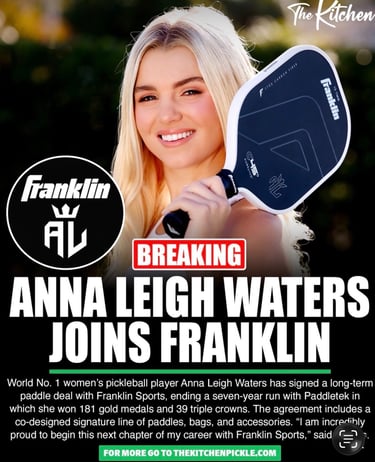
The announcement that Anna Leigh Waters has signed with Franklin Sports after seven years with Paddletek has been framed as a landmark moment in professional pickleball.
From a business and marketing perspective, that’s true.
From a performance perspective, it reinforces a reality most recreational players overlook:
Elite players win because of technique, athleticism, and decision-making—not because of the paddle.
Anna Leigh dominated the sport with Paddletek. She will continue to dominate with Franklin. And the truth is, she would likely beat the vast majority of players with almost any modern paddle on the market.
That’s not a criticism of any brand. It’s simply acknowledging where performance actually comes from.
What Sponsorships Really Mean
At the professional level, paddle changes are rarely about performance gains. They are about:
Sponsorship value
Brand reach
Marketing alignment
Long-term business opportunity
When the best player in the world uses a paddle, people buy that paddle—not because it transforms their game, but because association sells. This happens in every sport.
The Paddle-Chasing Cycle Most Players Fall Into
Many players believe the next paddle will finally unlock their game:
More power
More spin
A softer or “plusher” feel
And while some paddles feel great initially, they often give something up:
Control under pressure
Consistent spin over time
Predictable touch at the net
After a few weeks, most players realize something important: Their results haven’t really changed. That’s because once you’re using a quality modern paddle, differences between paddles are usually incremental—not transformational.
The Reality No One Talks About: Paddles Wear Out
All paddles wear out. Grit fades. Faces soften. Performance declines. For an actively used paddle, 6–12 months is a realistic lifespan. The real challenge most players face isn’t replacing a paddle—it’s replacing the same paddle.
Too often, when it’s time to replace it:
The model is discontinued
A “new version” is released
Additional features are added
The price jumps significantly
Players are then pushed into paying more for a paddle they didn’t ask to upgrade—just to keep playing at the same level.
The Pickleball Partners Paddle Philosophy
At Pickleball Partners, we’ve tested countless paddles. We’ve seen paddles with incredible plush feel that lacked control.
Others offered power but sacrificed spin or consistency.
Our philosophy has always been simple: Balance matters more than hype.
That’s why we continue to offer the Endura Fusion—a true all-court paddle that delivers reliable performance across power, spin, and control. When it wears out, you replace it with the same paddle, at an honest and attractive price, without being forced into unnecessary upgrades.
And when we had to prioritize? We chose control.
Why Control Comes First
For most players, control wins more points than power or spin.
That’s exactly why we created the Endura Ignite for recreational play:
Approximately 90% control
Around 80% spin
About 75% power (you have to know how to generate your own power)
It’s designed to reduce unforced errors, build confidence, and allow players to develop proper technique—rather than overpowering the ball and losing consistency.
Final Thought
Anna Leigh Waters didn’t become the best because of a paddle. Paddles benefit from her greatness—not the other way around.
Find a paddle that gives you balance, consistency, and control. Accept that paddles wear out. Don’t overpay chasing features you don’t need.
Then do the thing that actually changes your game: Work on your technique.
That’s where improvement really happens.